Weekly updatesOct 05, 2026
Weekly Market Outlook | September 28 - October 4, 2026
Edge Capital's weekly assessment of geopolitical risk, capital flows, protocol developments, and market structure across digital assets

Tokenization is no longer a proof-of-concept exercise. Over 2025, the value of tokenized real-world assets excluding stablecoins scaled to roughly $18B, with growth driven by institutional use rather than crypto market cycles. Adoption is clustering where tokenization materially improves capital efficiency, not where it simply extends access or trading hours. This signals a shift from experimentation toward balance sheet driven deployment.
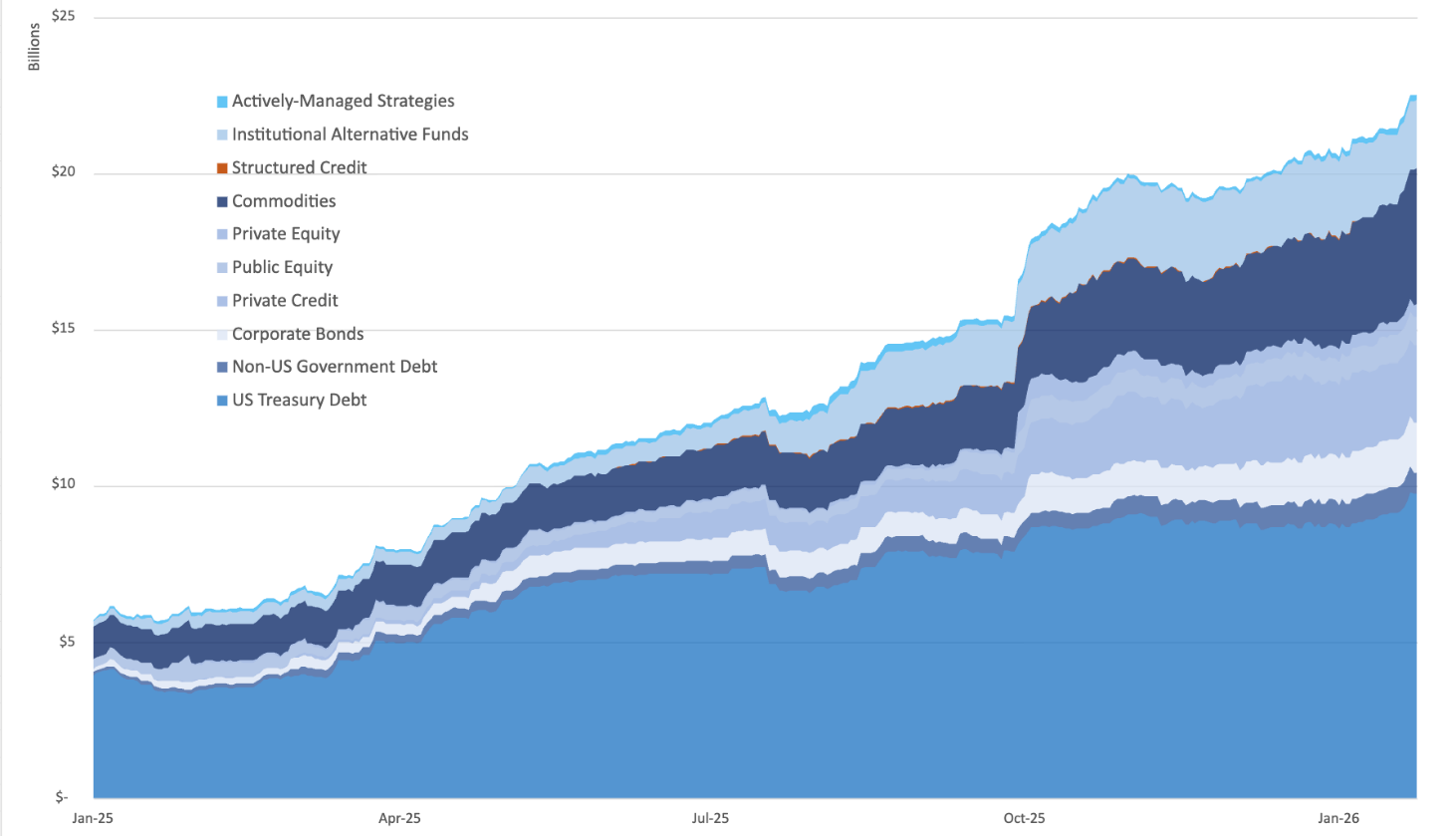
Tokenized U.S. Treasuries illustrate where tokenization delivers immediate economic value. Treasuries dominate not for yield, but because they sit at the core of institutional liquidity and collateral management. In this segment, tokenization functions as a settlement and collateral upgrade, enabling faster reuse of capital, tighter margining, and intraday mobility across venues, allowing the same collateral to support more trades and margin calls within a trading day.
Private credit and fund structures are expanding for similar reasons, but remain constrained by bespoke underwriting and slower standardization. A further bottleneck is the limited transparency of underlying loan and asset exposures, which makes institutional risk assessment and scaling more difficult.
Tokenized equities remain early, but strategically important. Total onchain value is still below $1B, reflecting structural and regulatory constraints that limit near-term scale. However, the 2025 launch of regulated tokenized equity products for non-U.S. users signals growing acceptance of onchain distribution within existing market frameworks. While adoption remains gradual, equities represent the largest long-term addressable opportunity for tokenization if these frictions ease.
Our key takeaway is that tokenization is scaling selectively rather than uniformly. Capital is flowing first into instruments that sit at the intersection of payments, collateral, and treasury management, positioning blockchain infrastructure as a capital efficiency layer rather than a parallel financial system. Heading into 2026, tokenized RWAs and stablecoins increasingly function as the settlement and collateral layer for onchain capital markets.
Disclaimer
This communication is for information purposes only and is not an advertisement, an offer, invitation or a solicitation to buy or sell securities or investment products, an official confirmation of any kind and is not intended as investment advice or recommendation. Before making an investment decision, investors should ensure they have sufficient information to ascertain the legal, financial, tax and regulatory consequences of an investment to enable them to make an informed investment decision. The information in this communication is subject to change without notice. No warranty is made as to the completeness or accuracy of the information contained in this communication, and the information in this email may be erroneous, invalid and/or unsubstantiated. The sender therefore does not accept liability for any errors, omissions or adverse consequences in the contents of this message which arise as a result of e-mail transmission or for any other reason.
The performance and value of any financial product may fluctuate and may be subject to sudden and large movements that could result in a loss equal to or in excess of the amount invested. Past performance is not a guide to future performance, future returns are not guaranteed, and a loss of original capital may occur. The presented figures are based on estimates, assumptions, models and third-party data, any or all of which may prove to be inaccurate.