
Weekly updatesJan 26, 2026
Weekly Market Outlook | Jan 19 - 25, 2026
Edge Capital’s weekly assessment of geopolitical risk, capital flows, protocol developments, and market structure across digital assets

BTCFi, or Bitcoin-native and Bitcoin-secured financial applications, represents a structural evolution in how Bitcoin can participate in global finance. It shifts Bitcoin's role from a passive store of value into programmable, collateral-like capital. Yet, Bitcoin's base layer remains deliberately limited in programmability and throughput, preserving the conservative design principles that sustain its trust, but constrain native financial activity.
Bitcoin represents over half of the global crypto-asset market, with a total value of around US$2.2 trillion as of October 2025. Yet only around 216,000 BTC are currently tokenized for usage in decentralized finance (DeFi) across major wrappers (WBTC, cbBTC, tBTC, and Lombard's LBTC), representing less than 1.1% of circulating supply. Even after including Binance BTCB, the combined tokenized and pegged total remains around 280,000 BTC, or about 1.4% of supply.
Separately, approximately 57,000 BTC are staked through Babylon's Bitcoin staking protocol, equivalent to about 0.3% of the circulating supply and roughly US$6 billion in value, with delegated or liquid-staking products emerging via platforms such as Lombard Finance and Solv Protocol. These developments signal the early mobilization of previously idle Bitcoin into productive, yield-generating use cases. Nevertheless, over US$1 trillion in Bitcoin value remains effectively dormant, a latent pool of capital that could be unlocked through trust-minimized systems anchored to Bitcoin's base layer.
Most Bitcoin Layer 2 (L2) projects are still in early stages compared with Ethereum's rollup ecosystem, which currently sets the benchmark for scalable, trust-minimized design, even though it is not yet fully decentralized in practice. On Bitcoin, most L2s use sidechain-, validium- or commit-chain-style architectures that introduce additional trust assumptions in sequencing, bridging, or data availability. Researchers note that fully trust-minimized rollups on Bitcoin, with native proof verification and data availability enforced on the base layer, would likely require protocol changes, such as introducing new opcodes via soft-fork.
Bitcoin's long-term security depends on the gradual replacement of block subsidies with market-driven fees. Activity surges such as Ordinals, BRC-20, and later Runes around the April 2024 halving demonstrated that new use cases can generate meaningful, albeit temporary, increases in miner revenue.
Emerging research, including BitVM, BitVM2, and BitVM3, shows potential for verifiable off-chain computation with on-chain dispute mechanisms on Bitcoin without changing consensus. In parallel, opcode proposals such as OP_CAT (BIP-347) and OP_CHECKTEMPLATEVERIFY (CTV, BIP-119) could enable covenant-style controls. None of these are active on mainnet; both the opcode proposals and production-grade BitVM systems require further research, testing, and broad community consensus for any eventual soft-fork or deployment.
If only 5% of Bitcoin's market capitalization were deployed through BTCFi, it would represent over US$100 billion in productive capital. This illustrates the scale of Bitcoin's next frontier: evolving from digital gold to digital infrastructure, provided ongoing advances in programmability, data availability, and bridge security continue.
Bitcoin's design emphasizes simplicity, immutability, and decentralization. These principles safeguard the network's integrity but limit its programmability. With ~10-minute block intervals and a conservative scripting system that is intentionally not Turing-complete, Bitcoin processes roughly 3–7 transactions per second. The result is exceptional security and censorship resistance, but limited flexibility for complex on-chain financial logic.
The Ethereum ecosystem remains the dominant platform for programmable finance. On recent snapshots, Ethereum's DeFi total value locked (TVL) is roughly US $85-95 billion, representing ~55-60% of total DeFi TVL. With ETH's market cap of around US $467 billion, that implies DeFi TVL of roughly ~18-20% of ETH's market value. Base-layer staking reached approximately 35.7 million ETH, or ~29–30% of circulating supply, as of mid-2025, with daily fluctuations as new ETH is staked or withdrawn.
By contrast, Bitcoin's participation remains much lower. At a market capitalization of roughly US $2.2 trillion, Bitcoin's on-chain DeFi activity accounts for only ~US $5–6 billion, or ~0.3% of its market value. Roughly ~216 k BTC are tokenized across major wrappers - WBTC (~127 k), cbBTC (~71 k), tBTC (~6.3 k), and Lombard's LBTC (~12 k) - and, including Binance's BTCB (~65 k), this brings the combined tokenized total to about ~281–282 k BTC, representing roughly 1.4% of Bitcoin's circulating supply. In addition, approximately ~57 k BTC (~0.3%) are staked through Babylon's Bitcoin staking protocol; of that total, ~12 k BTC correspond to Lombard's LBTC, already counted in the tokenized total, leaving a net-additional (non-LBTC) stake of ~45 k BTC.
This gap underscores Bitcoin's paradox: the most secure and liquid digital asset remains under-utilized in programmable finance. The opportunity for BTCFi lies in activating this dormant capital through trust-minimized, Bitcoin-secured infrastructure that preserves Bitcoin's decentralization and security model. Many long-term holders could be incentivized to deploy their BTC if they could earn yield or use it in DeFi without relinquishing custody or introducing new trust assumptions.
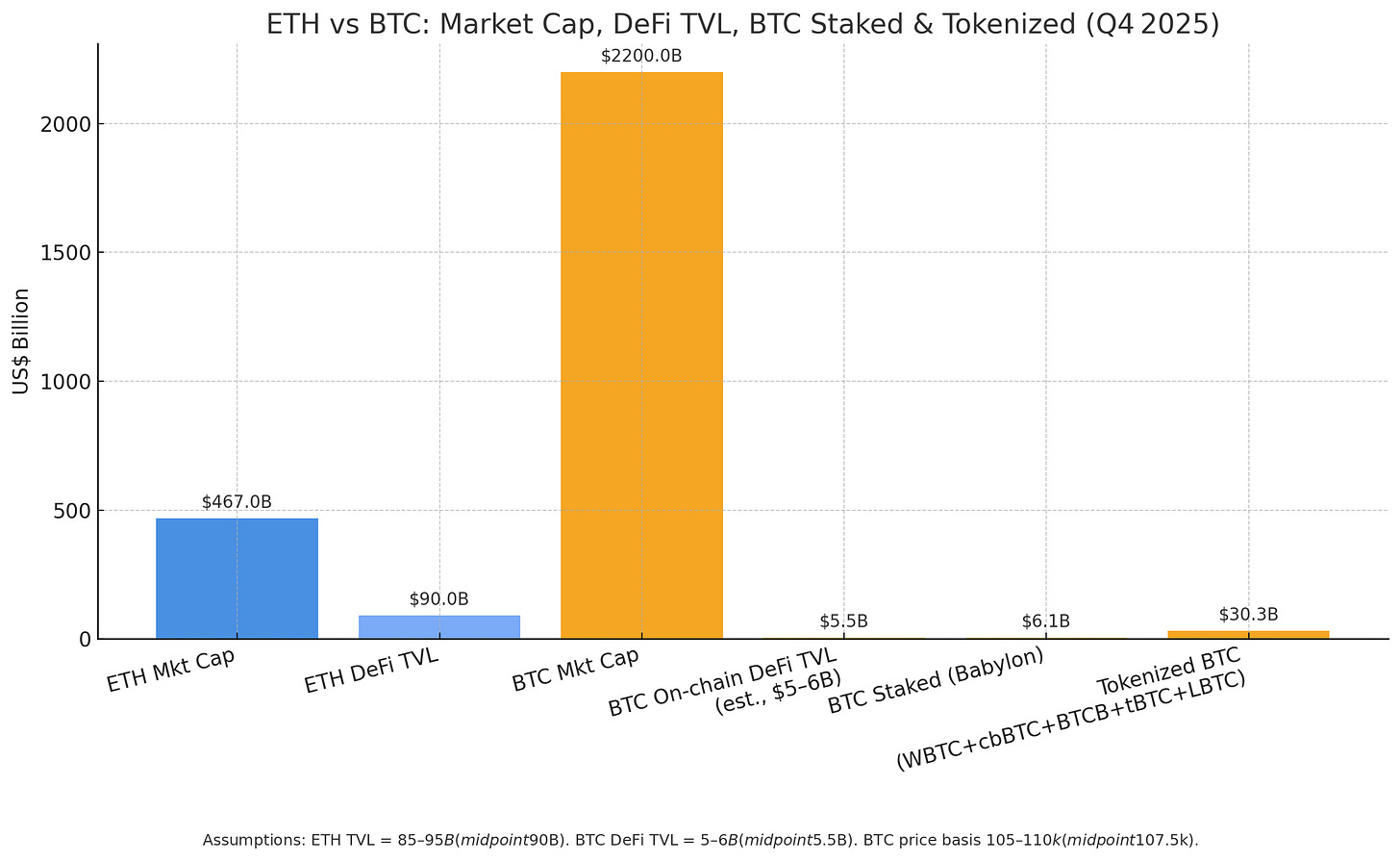
Over 60% of Bitcoin's circulating supply has remained unmoved for more than a year, a historic high that underscores strong long-term holder conviction but also reveals a vast reserve of idle capital. By contrast, roughly one-fifth of Ethereum's market value is actively deployed in DeFi through staking, lending, and liquidity protocols. Even when including both tokenized and native assets, Bitcoin's financially active share remains below 1.5% of its total supply.
This imbalance defines BTCFi's opportunity: to unlock yield and capital efficiency while preserving Bitcoin's conservative trust and security model. Even though Bitcoin's DeFi penetration remains small, the ecosystem has expanded at an extraordinary pace. Since 2023, total BTC-linked financial activity has grown more than twentyfold, signaling the early activation of what has long been a dormant trillion-dollar asset base.
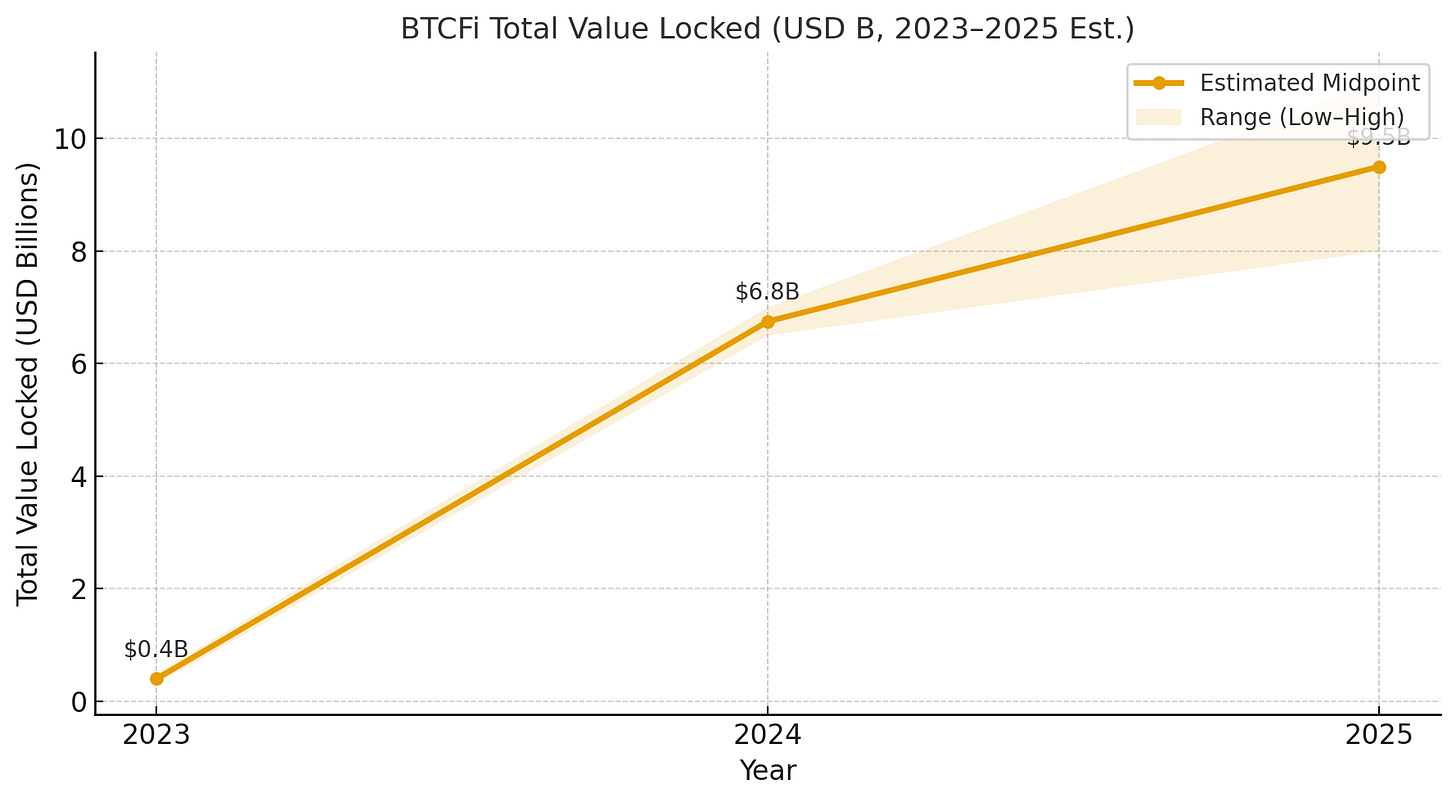
By mid-2025 the Bitcoin "programmable finance" ecosystem became measurably active. The native staking protocol Babylon Labs accounted for roughly US $5-6 billion of BTC staking (≈ 57,000 BTC). The liquid-staking token Lombard Staked BTC (LBTC) on Babylon saw a market value of approximately US $1.3-1.5 billion (~11.8-12 k BTC × ~$110 k/BTC). Other segments, such as wrapped-BTC tokens and payment channel liquidity, contribute further billions, including ~US $0.6-0.7 billion in tBTC and roughly US $0.45-0.5 billion in the Lightning Network (channel liquidity). Side-chain systems such as the Liquid Network may add an additional ~US $3 billion of capacity. In aggregate, ≈ US $10-13 billion of Bitcoin-denominated assets were engaged in finance-style activity by mid-2025. While still modest compared with Ethereum's DeFi base of US $85-95 billion, the acceleration highlights Bitcoin's emerging role as collateral and utility in decentralized systems.
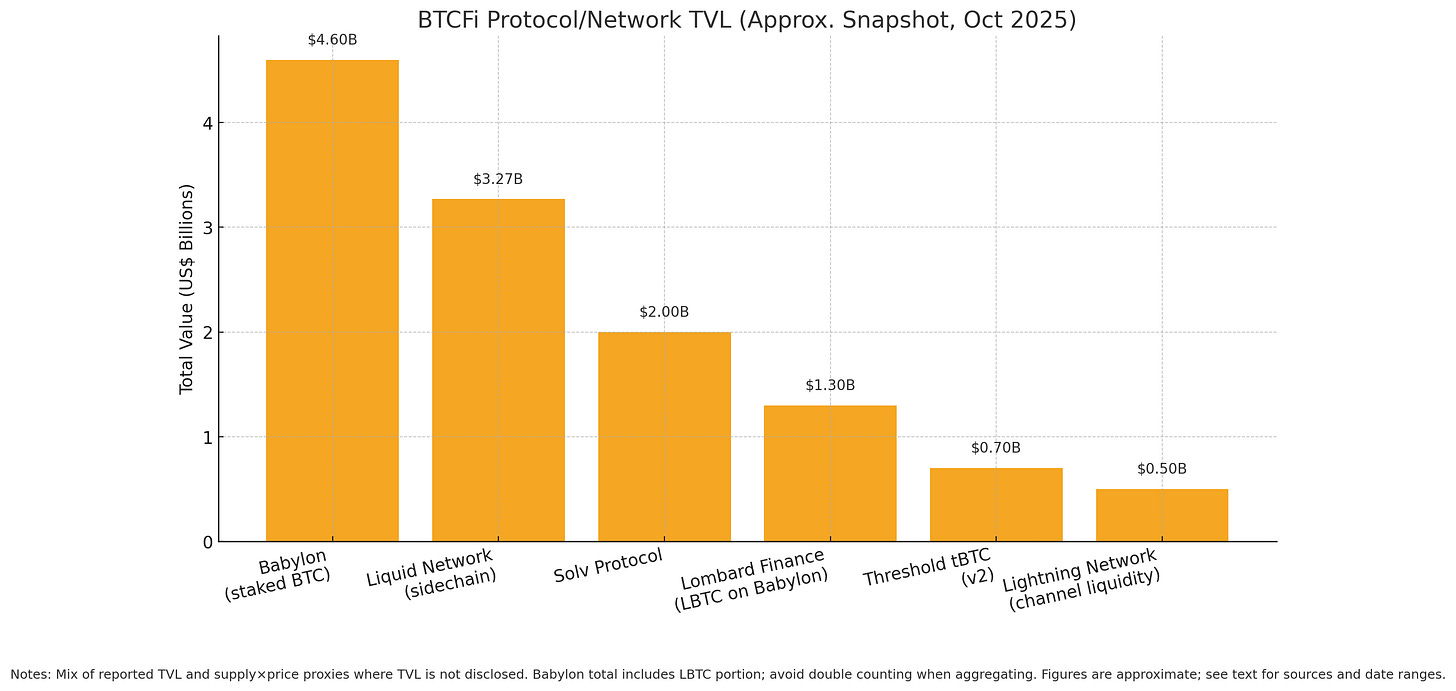
Within this composition, Bitcoin-secured designs, led by Babylon's self-custodial, on-chain-verified staking, have grown fastest. However, wrapped or custodial BTC remains material through programs such as Solv and Lombard. Rather than a wholesale shift away from wrapped assets, a hybrid structure is forming in which native and cross-chain liquidity coexist, reflecting Bitcoin's gradual move from static value storage to composable financial infrastructure.
For many holders, however, the barrier is not opportunity but trust. Most Bitcoiners prioritize self-custody and minimal reliance on intermediaries, making them cautious toward bridges, federations, or smart-contract wrappers. Future adoption depends on transparent risk frameworks, verifiable bridge mechanics, and credible insurance or protection layers that enable participation without key surrender. Regulation is an additional determinant: the European Union's MiCA framework (effective 2024) provides a clear taxonomy for asset-referenced and e-money tokens, improving compliance visibility for tokenized BTC products. In contrast, U.S. policy toward staking, custody, and wrapped assets remains fragmented, creating uncertainty for service providers and investors alike.
BTCFi's implications extend beyond capital efficiency. Following the April 2024 halving, block rewards fell to 3.125 BTC, sharply reducing miner income from issuance. Transaction fees temporarily surged during Runes-driven activity, then normalized at historically low levels. Sustained BTCFi adoption could generate recurring on-chain demand and fee revenue, supporting the network's long-term security budget as issuance declines. This linkage between liquidity deployment and protocol sustainability positions BTCFi not merely as a DeFi trend but as a strategic economic layer for Bitcoin itself.
If even a modest fraction of dormant BTC, say 5% of supply, were mobilized through Bitcoin-anchored protocols, the addressable market could exceed US$100 billion in on-chain liquidity, rivaling mid-cycle Ethereum DeFi levels. Momentum across Babylon, Lombard, Solv, and emerging modular frameworks suggests that this process is already underway. BTCFi's next phase will hinge on three converging forces: institutional participation, credible bridge security, and the progressive normalization of Bitcoin as a yield-bearing, productive asset.
Bitcoin's journey toward programmability began with foundational protocol upgrades. The Taproot soft fork (November 2021) introduced Schnorr signatures and Tapscript, implementing Merkelized Abstract Syntax Trees (MAST) to enhance efficiency, privacy, and flexibility in Bitcoin scripting. Taproot enables both key-path and script-path spending, allowing participants to aggregate signatures efficiently and reveal only the executed branch of a script. This design reduces transaction size, improves privacy, and enables more expressive spending conditions that previously required complex off-chain coordination. While Taproot expands Bitcoin's transaction logic and supports more advanced "contract-like" structures, its scripting environment remains intentionally limited and non-Turing-complete, preserving Bitcoin's conservative security model.
Building on this foundation, developers began exploring inscription-based protocols. In 2023, Ordinals introduced a method to attach arbitrary data to individual satoshis, enabling NFT-like assets directly on Bitcoin. Later that year, BRC-20 emerged as an experimental standard for representing fungible tokens through JSON inscriptions combined with off-chain indexers. In 2024, the Runes protocol presented a more UTXO-native approach for fungible tokens designed to reduce overhead and UTXO bloat compared with BRC-20. Runes still relies on indexing infrastructure for wallet and explorer integration but aligns more cleanly with Bitcoin's native transaction model.
Collectively, these innovations mark a technical and cultural shift: beyond its role as digital gold, Bitcoin is increasingly being explored as a platform for simple on-chain token primitives and contract-like spending conditions.
BitVM, introduced in late 2023, demonstrated that complex computation can be executed off-chain and verified on-chain on Bitcoin without changing consensus rules. By combining Taproot's Merkle tree structures with pre-signed transactions, BitVM introduced a challenge-response model in which a prover performs computation off-chain and a verifier can contest incorrect results step by step. If a dispute arises, Bitcoin's existing scripting system enforces correctness through on-chain penalties.
This architecture effectively extends Bitcoin's limited scripting environment into a verifiable computation layer that operates within current consensus limits, expanding functionality without requiring new opcodes or forks. Early implementations are experimental and primarily two-party, but they show how Bitcoin's base layer can secure advanced logic cryptographically rather than through new opcodes.
Since the original paper, BitVM2 (2024) and BitVM3 (2025) have refined this model, reducing the cost and complexity of on-chain disputes by several orders of magnitude and introducing more efficient state proofs. BitVM2 introduced a single-round fraud-proof architecture using a SNARK verifier, and BitVM3 proposes garbled-circuit optimizations that reduce on-chain dispute costs by roughly 1,000×. These versions remain experimental but demonstrate a credible path toward trust-minimized, programmable computation secured by Bitcoin.
In parallel, proposed opcodes such as OP_CAT (for concatenation and introspection) and OP_CHECKTEMPLATEVERIFY (CTV, BIP-119) could enable covenant-style controls, allowing developers to set constraints on how funds can be spent or combined. Neither opcode is active on mainnet, and both would require a soft fork and broad community consensus.
Together, these research directions—BitVM, BitVM2, and BitVM3 for verifiable off-chain computation, alongside opcode proposals such as OP_CAT and OP_CTV for covenant-style transaction logic—reflect the broader effort to expand Bitcoin's expressiveness without compromising its conservative security model. If realized, these technologies could enable verifiable bridges, programmable derivatives, and settlement systems that remain anchored to Bitcoin's base-layer assurances, marking a meaningful step toward scalable Bitcoin-native programmability.
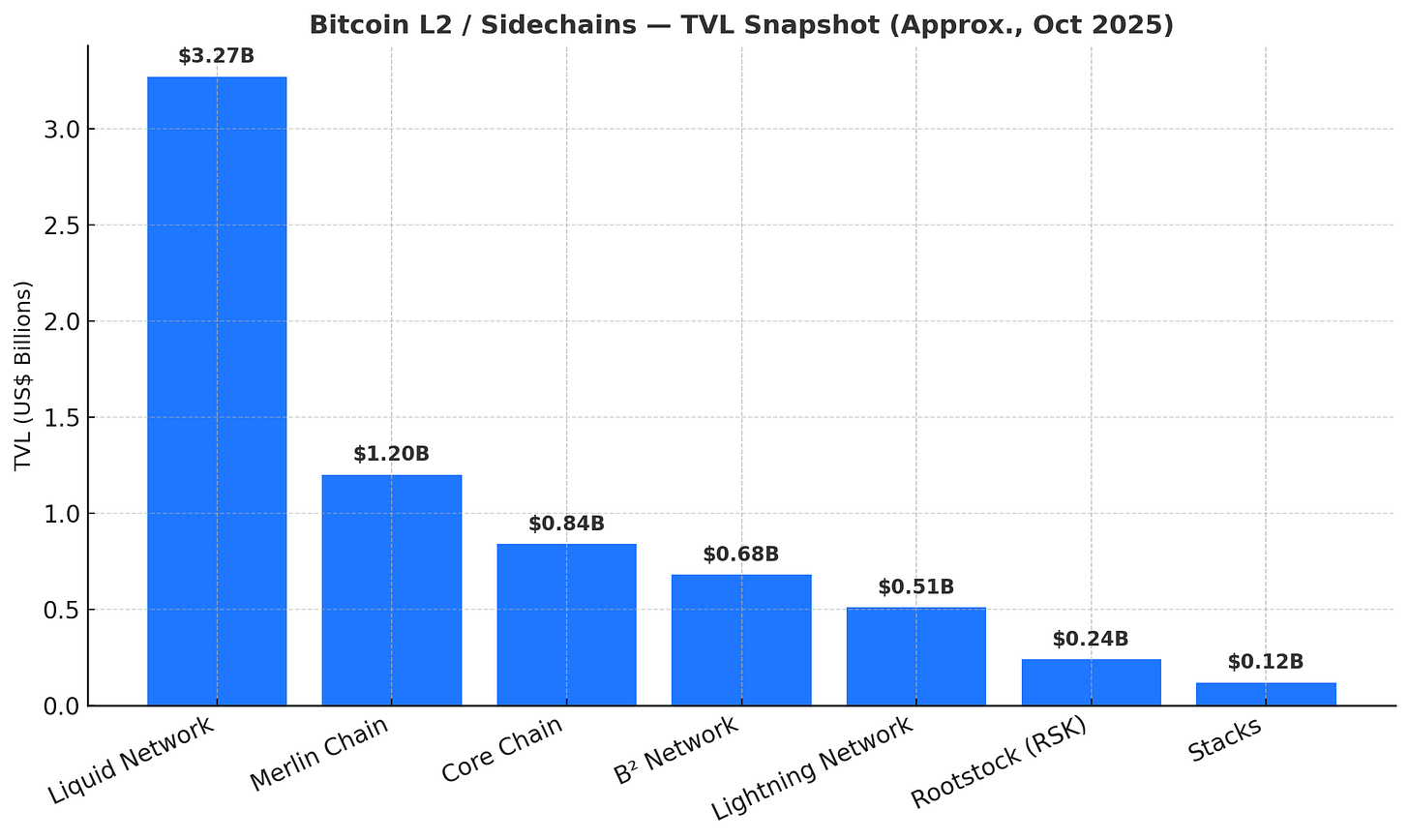
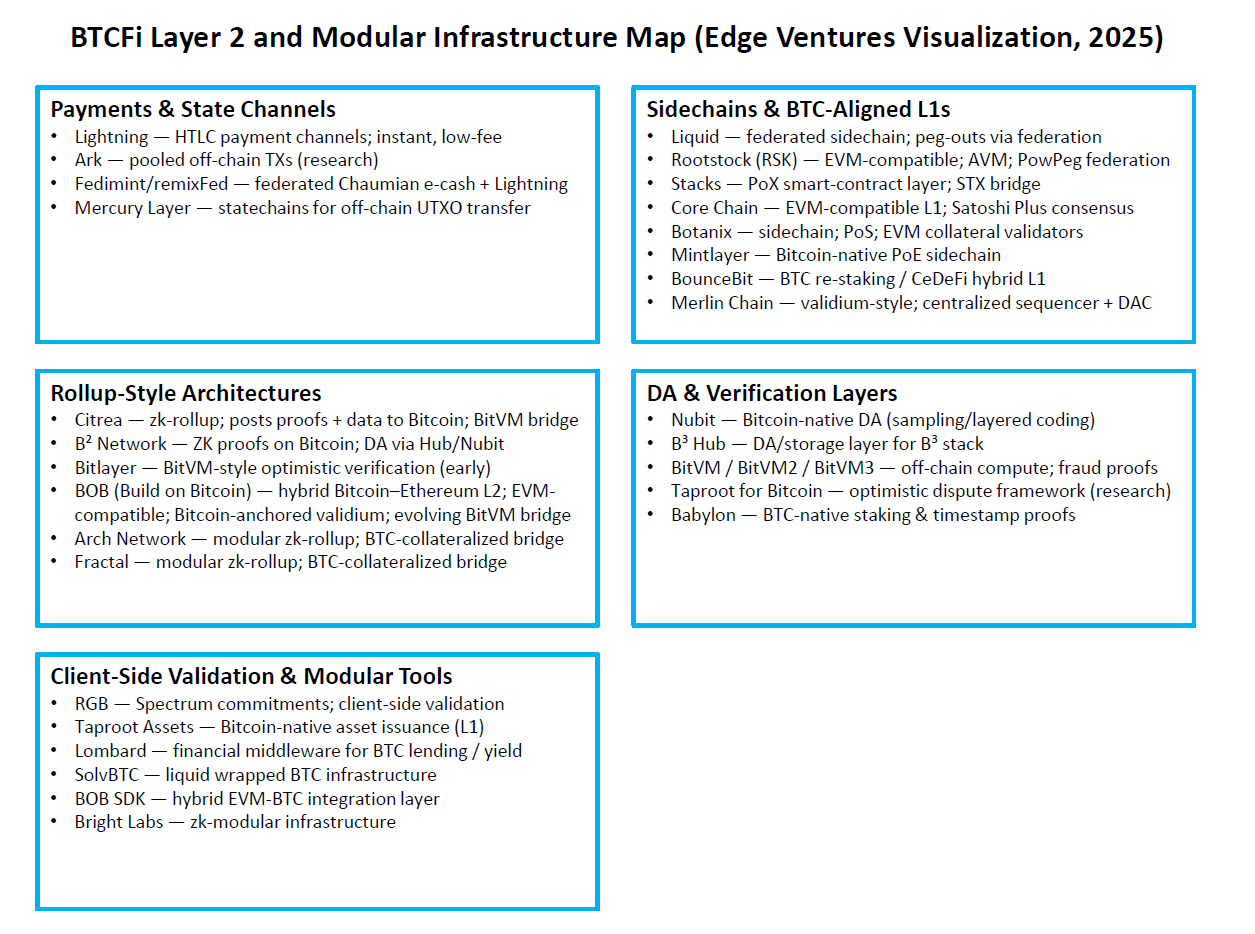
Bitcoin's design optimizes for decentralization and security, leaving scalability to external layers. Over time, this architecture has evolved into a multi-layered ecosystem of payment channels, sidechains, and emerging rollup-style solutions, each with distinct trade-offs in performance, flexibility, and trust.
The Lightning Network uses hashed timelock contracts (HTLCs) to enable instant, low-fee peer-to-peer payments by settling only channel openings and closings on-chain, while most activity occurs off-chain. It scales efficiently for payments but does not support general smart-contract execution.
Sidechains such as Rootstock and Liquid expand Bitcoin's functionality by operating independent blockchains pegged to BTC. Rootstock provides EVM compatibility through a two-way peg managed by the permissioned PowPeg federation, combining merge-mining with a multi-signature bridge. Liquid is a federated sidechain run by the Liquid Federation, enabling faster settlement and asset issuance but requiring trust in its functionaries.
Core Chain, sometimes described as a Bitcoin sidechain, is actually an independent EVM-compatible Layer 1 aligned with Bitcoin. It employs a hybrid Satoshi Plus consensus (delegated proof-of-stake + delegated proof-of-work), offering higher throughput but introducing distinct governance and trust assumptions compared with Bitcoin itself.
Stacks takes a distinct approach. Rather than functioning as a classical sidechain, it uses a proof-of-transfer (PoX) mechanism that anchors Stacks blocks to Bitcoin's base chain. BTC is used as the settlement and reward asset, while the Stacks chain executes smart contracts in Clarity, a decidable language designed for predictable execution. This architecture allows applications and assets on Stacks to inherit Bitcoin's finality and security assurances indirectly, though it relies on separate validators and does not use Bitcoin's miners for transaction execution.
BOB (Build on Bitcoin) represents a newer hybrid approach that combines Bitcoin settlement with an EVM-compatible execution layer. It anchors state commitments to Bitcoin while operating as an optimistic or validium-style Layer 2, designed to bridge Bitcoin and Ethereum ecosystems. While still early, BOB's design reflects the next generation of Bitcoin-anchored scalability frameworks, those aiming to pair Bitcoin's base-layer finality with programmable, high-throughput environments.
The newest frontier involves Bitcoin-anchored rollup architectures, though fully trust-minimized rollups on Bitcoin do not yet exist. Achieving native proof verification and enforcing complete data availability (DA) directly on Bitcoin's base layer would likely require protocol changes, such as new opcodes activated via soft fork, so all current implementations introduce additional trust assumptions. Some teams claim they can achieve rollup-like systems anchored to Bitcoin without a fork (for example, Citrea's "sovereign zk rollup"), but this remains an active area of research and debate precisely because enforcing DA on Bitcoin and verifying proofs natively are the hardest problems.
Citrea, developed by Chainway, proposes an EVM-compatible zk-rollup that posts validity proofs and transaction data to Bitcoin while employing a BitVM-based bridge ("Clementine") for trust-minimized verification, an approach intended to keep both settlement and data availability closely tied to Bitcoin's base layer.
Merlin, by contrast, functions as a validium-style chain with a centralized sequencer and a data-availability committee; transaction data are not published to Bitcoin L1, and bridging is not enforced by Bitcoin consensus.
B² Network anchors zero-knowledge proofs to Bitcoin but relies on its own B² Hub and external DA services (e.g., Nubit or Arweave), meaning the rollup's full state cannot be reconstructed from Bitcoin alone.
Arch Network represents another emerging approach, positioning itself as a modular Bitcoin Layer 2 that uses zero-knowledge circuits and validity proofs to settle on Bitcoin while off-loading execution and DA to modular layers. Arch aims to offer a "ZK Settlement Layer" for Bitcoin that combines Ethereum-style programmability with Bitcoin-anchored security, though like other early-stage implementations it still relies on off-chain DA and sequencing trust.
Together, these projects represent early experiments in extending Bitcoin's scalability and programmability while remaining anchored to its security model. Their architectures differ substantially in trust, bridge design, and DA guarantees, illustrating both the promise and the technical limitations of Bitcoin's emerging L2 landscape. Payment channels, sidechains, and rollup-style systems form complementary parts of Bitcoin's scalability roadmap, a modular ecosystem in which security, execution, and data availability are increasingly distinct yet interlinked, and where each design balances throughput against varying degrees of trust.
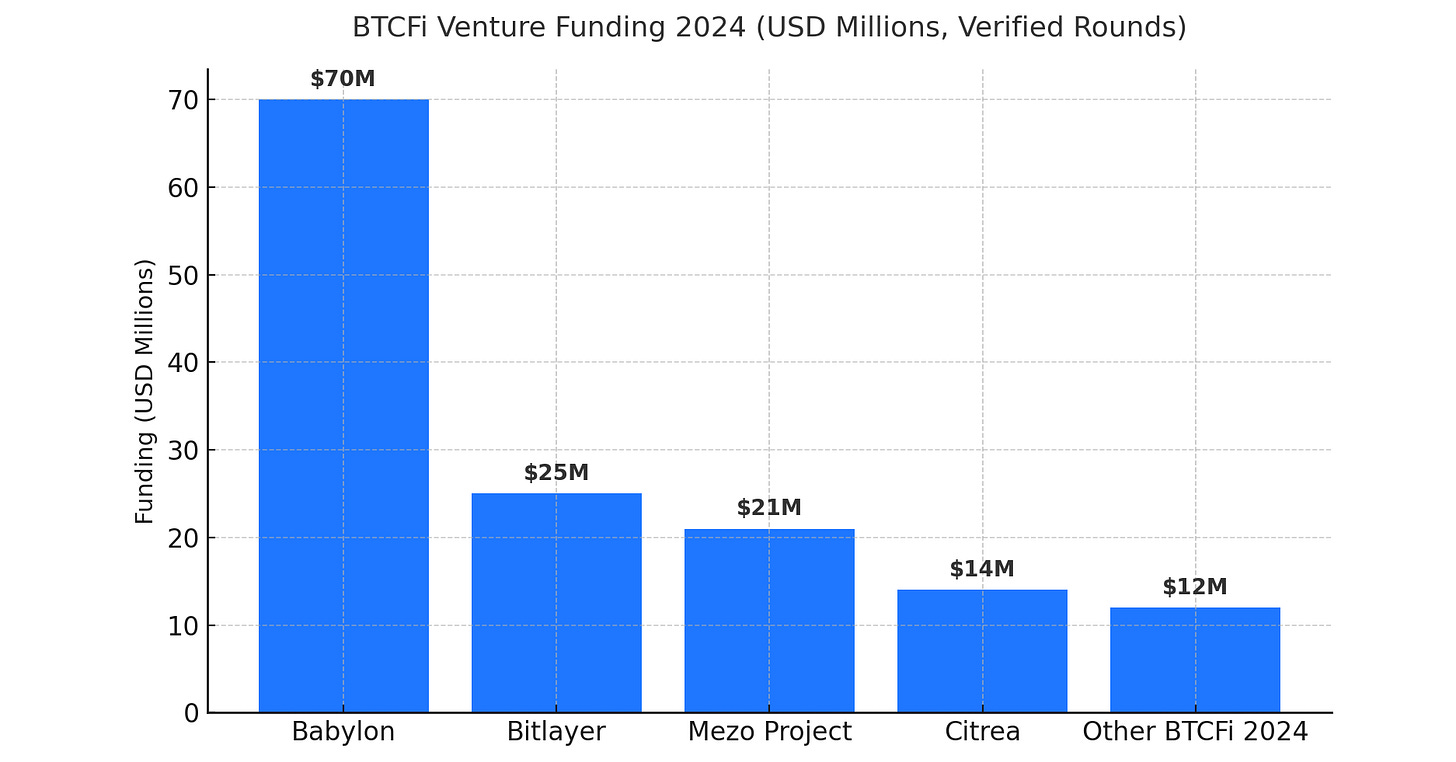
The surge of innovation following Taproot, and the emergence of new verification models like BitVM, has catalyzed a wave of Bitcoin infrastructure building and corresponding venture investment. Since early 2024, capital has flowed into projects developing Bitcoin-aligned Layer-2 frameworks, modular data-availability (DA) systems, and cross-chain bridges. Disclosed venture funding across these categories comfortably exceeded US$150 million during 2024 alone, underscoring growing conviction that programmability and utility are becoming central to Bitcoin's long-term security model.
Among the most notable raises, Babylon secured US$70 million led by Paradigm with Polychain participation, reflecting deep investor interest in BTC-staked yield and restaking primitives. Mezo closed a US$21 million Series A led by Pantera with Multicoin participating. Bitlayer announced a US$5 million seed round and a US$50 million ecosystem program, while Citrea (Chainway Labs) raised US$16.7 million across a seed led by Galaxy and a subsequent US$14 million Series A led by Founders Fund. Other rounds included Botanix (US$8.5 million), BounceBit (US$6 million), Ark Labs (US$2.5 million), Nubit (US$11 million), and additional undisclosed raises from projects such as Merlin and B² Network. In early 2025, Alpen Labs added a US$8.5 million strategic round co-led by DBA and Cyber Fund.
This capital clustering reflects a coherent infrastructure thesis: Bitcoin's economic security ultimately depends on sustained on-chain utility, and utility scales through programmability. Developers and investors are converging on designs that combine scalability with trust-minimization, rollups, bridge layers, and modular execution environments aligned with Bitcoin's conservative ethos.
Institutional catalysts have reinforced this trajectory. The January 2024 approval of U.S. spot Bitcoin ETFs broadened regulated access and improved allocator sentiment, indirectly boosting confidence in Bitcoin-backed financial products. Although ETF assets remain custodied off-chain, their approval marked a psychological inflection, signaling to capital markets that Bitcoin infrastructure is investable and institutionally relevant.
The sector remains early and heterogeneous, architectures vary in bridge security, data-availability models, and decentralization, but the underlying trend is clear. Capital, talent, and institutional attention are coalescing around Bitcoin's next frontier: programmable liquidity built on the world's most secure base layer.
BTCFi is a structural evolution of Bitcoin's place in global finance. Ethereum has already demonstrated the viability and scale of decentralized capital markets, DeFi's total value locked recently returned to roughly $150–$160 billion, with Ethereum hosting the majority of that activity, while Bitcoin now has an opportunity to anchor parts of this market with its unmatched security, liquidity, and brand legitimacy.
In the near term, new Bitcoin-anchored Layer-2 frameworks and bridging models are broadening programmability and deepening liquidity. Depending on definition, tokenized BTC across chains already exceeds ~200k BTC, and Bitcoin-native DeFi has grown into the low-single-digit billions; with institutional infrastructure maturing, we see a credible path for Bitcoin-native TVL to reach >$10B over the next year, a projection, not a guarantee.
Longer term, incremental base-layer upgrades (e.g., OP_CTV, OP_CAT, and related covenant/introspection ideas), combined with BitVM-style verification and better UX standards, could move more financial logic onto Bitcoin-anchored rails without compromising its conservative consensus. These remain early-stage engineering efforts that will require community alignment before activation.
This transformation has three strategic implications:
In this view, BTCFi marks Bitcoin's "second act." The narrative of digital gold expands into digital infrastructure with yield: a conservative, infrastructure-first financial layer that leverages the world's most resilient ledger while minimizing trust in bridges and data availability. This evolution reframes Bitcoin from a passive store of value into the settlement backbone for a programmable, yield-generating, and institutionally-trusted financial ecosystem.
Bitcoin's first fifteen years established the era of digital scarcity; the next phase will define digital productivity. BTCFi is the pathway to transform Bitcoin's trillion-dollar balance sheet from dormant capital into an active financial substrate. Trust-minimized bridges, scalable execution layers (channels, sidechains, and emerging rollup architectures), and yield-oriented primitives are converging to make Bitcoin not only a foundation for decentralized finance but also a source of funding and collateral for it.
At Edge Ventures, we see this evolution as both structurally inevitable and strategically investable. Incentives across the ecosystem are aligned:
A well-architected BTCFi stack can serve all three constituencies, extending Bitcoin's simplicity and resilience into a modular, composable financial network anchored to its base layer and verified by open cryptography.
Ultimately, the defining opportunity lies in building a trustless institutional layer, one that enables secure, compliant, and auditable deployment of Bitcoin as productive capital. Unlocking this idle value through transparent, trust-minimized infrastructure could open trillions in addressable opportunity, positioning Bitcoin not merely as digital gold but as the institutional backbone of decentralized finance.
Bitcoin is no longer only the world's hardest asset; through BTCFi, it is becoming the world's hardest-working asset, productive collateral reinforcing the security of the very network on which it settles.
Sources
Data Sources & Assumptions (as of October 2025)